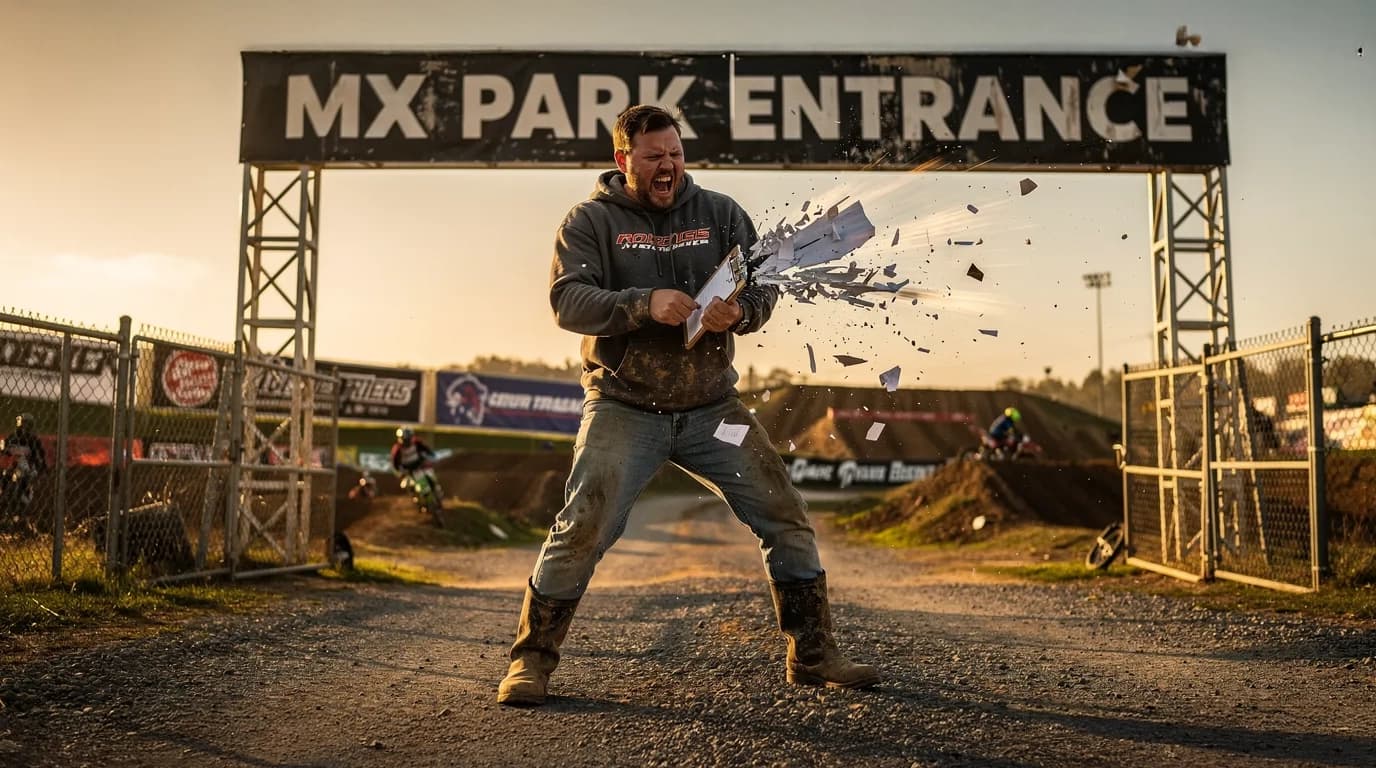
Every track owner knows the clipboard.
It lives at the gate. It holds a stack of paper waivers curling at the edges, a pen that half works, and a rubber band doing more than its share. On a busy Saturday it is a bottleneck, a line of riders and parents waiting to print their names while the first motos are already firing up. On a slow day it is a filing problem waiting to happen. And on the worst day, the day something actually goes wrong, it is the thing you go digging through a box in the office to find, hoping the right piece of paper is signed, legible, and where it is supposed to be.
The clipboard has run motocross tracks for decades. It is time to retire it.
That is what we built TrackPass to do.
The problem is not paper. It is what paper costs you.
It is easy to think of the paper waiver as a minor annoyance, a little clunky, a little old-fashioned, but basically fine. It is not fine. The paper waiver quietly costs track owners in four ways, and most owners have never added them up.
It costs you at the gate. Every rider who fills out a form on arrival is a rider standing in line instead of riding. Multiply that by a hundred riders on an event day and you have turned your entrance into a traffic jam during the exact hours you can least afford one.
It costs you in liability exposure. A paper waiver is only as good as the paper. Is it signed? Is it legible? Is it the current version? For a minor, is the guardian consent handled correctly and provably? When a waiver is the thing standing between you and a problem, "probably in the box somewhere" is not where you want to be.
It costs you in blindness. The clipboard tells you nothing. It cannot tell you how many riders came through last weekend, which passes sell and which do not, who your regulars are, or what your gate actually did on a given day. You are running a business on a feeling instead of on numbers.
It costs you in money that never makes it to the box. Cash at the gate is cash that gets miscounted, pocketed, waved through by a friend of a friend, or simply lost in the shuffle of a busy day. Every dollar that does not make it into the box is a dollar out of your pocket.
None of these are dramatic on their own. Together, over a season, they add up to real money, real risk, and real hours you will never get back.
What "going digital" should actually mean
There is a lot of software out there that promises to modernize a business and mostly just moves the headache onto a screen. We were determined not to build that. A track owner should not need to become an IT department to run their gate.
So we built TrackPass around a simple standard: it has to make ride day easier, not more complicated. If a piece of it made a track owner's Saturday harder, it did not ship.
Here is what that looks like in practice.
The waiver gets signed before anyone shows up. Riders sign one digital waiver on their phone or computer, ahead of time, from home. No paper, nothing to print, nothing to file, nothing to lose. And these are not waivers we cooked up. They come from the insurance side, they are built to be tamper-evident, and they handle minors and guardian consent the way that side of the business requires. If a day ever comes when the waiver matters, it holds up.
The pass gets bought online. A day pass, a season pass, an event pass, riders buy it before they arrive, and the money goes where it is supposed to go: to you. Not into a cash box to be counted twice and hoped over. Into your account.
The gate moves fast. On ride day you open a check-in board on a tablet, a computer, a phone, whatever you have got. Riders check in the way you decided they should: tapping their own name, or getting checked in and scanned by your staff. The line moves. The motos start on time.
You finally see your track. This is the part owners tell us they did not know they were missing. A dashboard shows you who is on your property right now, what is selling, and what your gate is doing, live. You know your riders. You know their bikes. You know your numbers. For the first time, the track is not a black box on race day. It is a business you can actually see.
Less paper. Less risk. A faster gate. And a real picture of your own operation.
Built with track owners, not at them
Here is the part that matters most, and the reason this is not just another piece of software parachuting in from the outside.
TrackPass came out of the Motocross Track Owner Roundtables, the ongoing conversations we have been having with the people who actually run tracks, about the actual problems they actually face. Waivers. Liability. Insurance. The gate. The cash box. The stuff that keeps a track owner up at night. TrackPass is a direct answer to those conversations, shaped by the people who will use it.
That is not a marketing line. It is a design philosophy. Track owners do not need a Silicon Valley product manager's idea of how a track should run. They need tools built around how tracks actually run: the weather, the volunteers, the family that shows up ten minutes before close, the kid on a 50 who needs a guardian signature, the regular who has been coming for fifteen years. Software that does not understand those realities is not worth the screen it is on.
So we are not finished building it. We are building it with the tracks that join us next.
The pilot: a few tracks, real attention
This summer, we are opening TrackPass to a small number of pilot tracks.
Small is the point. We are not trying to sign up everyone at once and disappear. We want a handful of tracks we can give real attention to, tracks whose owners will tell us what works, what does not, and what is missing, so we can build TrackPass into the best platform of its kind before we open it wider. The tracks that come in now are not just early users. They are co-authors. The platform that comes out the other side will have their fingerprints on it.
It is free to pilot. You get a tool that takes the paper, the gate jam, and the cash-box guesswork off your plate, and a direct line to shape it around what your track actually needs.
The clipboard had a good run. Decades, honestly. But the sport has moved forward in every other way, the bikes, the gear, the tracks themselves, and the way we run the gate is one of the last places still stuck in the paper era. That is a gap worth closing.