A good motocross jump starts with speed, not size. Decide how fast riders will arrive, shape the takeoff as a smooth curve up to the lip, and build a landing long enough to catch riders who come up a little short or a little long. Neither AMA nor FIM publishes jump sizes, so this page gives none.
Last checked November 4, 2026, against AMA's 2026 Racing Rulebook, FIM's 2025 circuit standards and published research on landing safety.
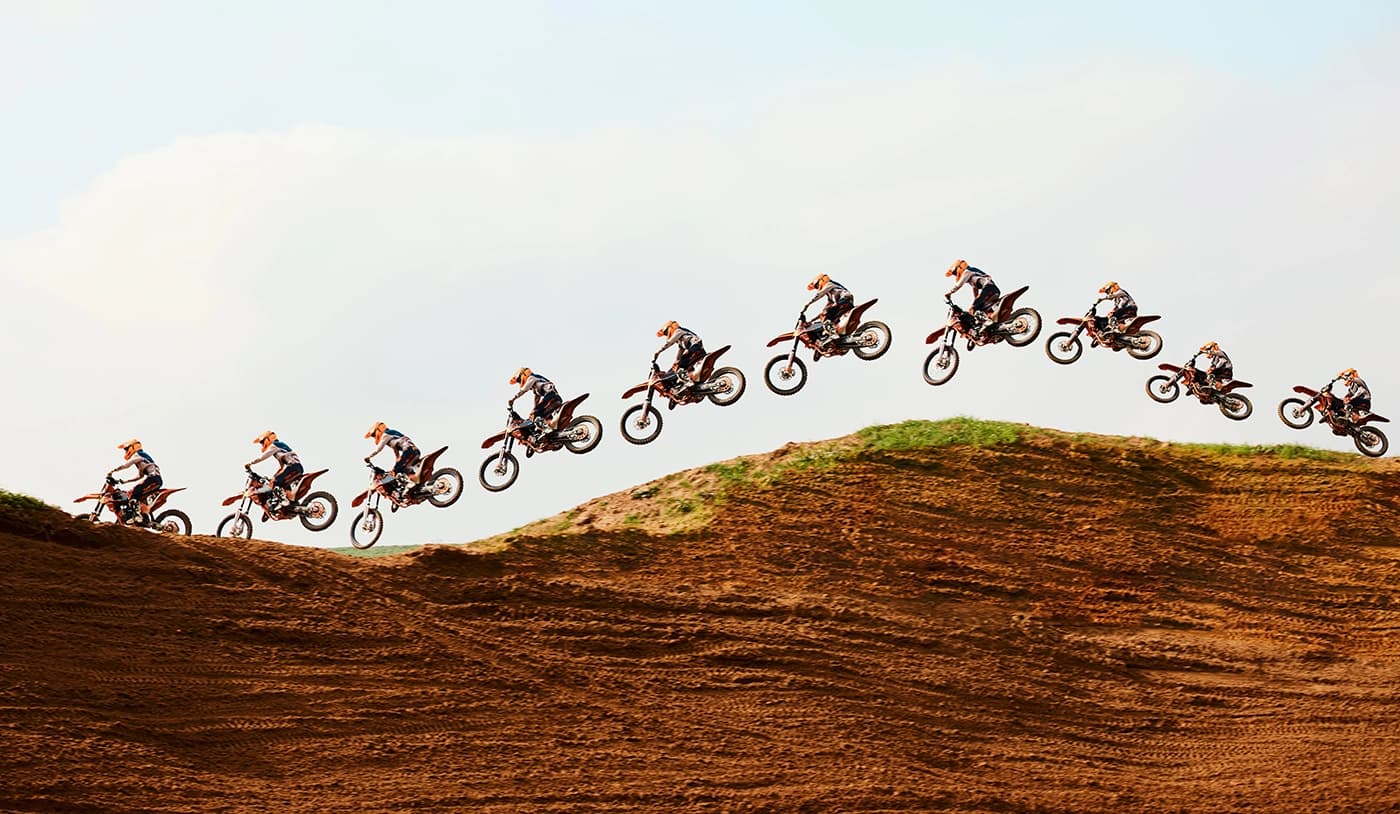
The jumps, side on
Pick a shape to see what it asks of a rider and what to get right when you build it.
Start with speed, not size
How far a rider flies grows with the square of their speed: twice as fast goes about four times as far. So a jump built for one speed is wrong at another. Fix the speed riders will carry into it first, then size the jump to it. MotoTerra works that out for a jump on your own land.
Takeoffs
- A smooth curve, not a ramp. The face should curve up to the lip, tightening gradually, so the bike is lifted steadily instead of bucked (Trailism). A straight ramp with a sharp edge kicks it.
- Gentle for beginners. Beginners need low faces and gentle curves, about 30 degrees (Lee McCormack, writing about bicycle jumps). A supercross practice-track guide uses 30-degree launch faces too (Medsker Racing College, 1999).
- No magic angle. 45 degrees is the farthest-flying angle only when the landing is level with the lip. Most landings sit lower, and then a lower angle carries farther. FIM's standard asks builders to give "special consideration" to the angle at jump faces and landing zones, and names no number.
Landings
A landing hurts least when it slopes away at about the angle the rider is falling, so the rider meets the dirt at a shallow angle. Terrain-park researchers measure this as equivalent fall height: how far you would have to drop straight onto flat ground to land as hard. A flat top is the hardest place to land, which is why coming up short on a tabletop hits hard even though there is no gap.
For ski terrain parks, the US Terrain Park Council recommends keeping every landing under 1.5 metres of equivalent fall height (Levy, Hubbard, McNeil and Swedberg, 2015). No such limit has been published for motocross, so treat it as a principle, not a target: build landings long, sloped and even, so short and long jumps still land on the slope.
Published limits
No governing body publishes beginner sizes, but some set limits. Motorcycling New Zealand's requirements for championship tracks (a draft for consultation) say:
- No jump taller than 3 metres.
- The landing at least 1 metre wider than the takeoff, in a straight line from it, well rounded with no peaked top, and with a long, gentle down ramp.
- On a double, the second jump about 400 millimetres lower than the first.
- A tabletop's flat top between 3 and 20 metres long.
- No triples.
The same supercross guide pairs its 30-degree launches with landings of 20, 15 or 10 degrees: the longer the jump, the flatter the landing (Medsker Racing College).
In the air: what a rider can fix
A jump that is built right still asks something of the rider. Physicists Jeffrey Giles and Charles Ross describe three moves ("The Physics of Motocross", The Physics Teacher, 1996):
- More height: compress the suspension on the face, by accelerating harder into the base of the ramp or pushing down on the bars and pegs, so it rebounds off the lip.
- Front wheel too high: shift weight forward, or lock the rear brake. Stopping the spinning rear wheel turns the whole bike nose-down.
- Front wheel too low: a burst of throttle spins the rear wheel faster and lifts the front.
Whoops and rolling waves
FIM's world-championship standard does not allow whoops. It allows rolling waves within limits: crests 8 to 10 metres apart, no more than 80 centimetres high, never on a downhill and never sharp-shaped (FIM 2025, section 4.11).
Before anyone rides it
- Test it. Have a competent rider try each jump and make the finishing touches, as FIM's standard asks.
- Keep the start clear. AMA's rulebook wants the start area free of humps and jumps, and FIM allows no jumps on the start straight.
- Know the flags. At an AMA race, jumps must be rolled under a yellow flag and under the red-cross flag, from the flag to the incident.
Questions riders ask
How big should a motocross jump be?
No governing body publishes sizes by skill or bike size: AMA's rulebook and FIM's circuit standards leave them to the builder. Size a jump from the speed riders will carry into it, because the distance a rider flies grows with the square of that speed. The one published cap we found is Motorcycling New Zealand's: no jump taller than 3 metres on a championship track.
What angle should a jump's takeoff be?
There is no single right number. On level ground, 45 degrees sends a rider farthest, but most landings sit lower than the lip, and then a lower angle carries farther. What matters most is a smooth curve up to the lip, never a straight ramp with a sharp edge.
How far apart should jumps be?
No standard gives a spacing. Each jump needs room to build speed before it and room to land and settle after it, and both depend on the speed riders carry. The one rule AMA and FIM both state: no jumps on the start straight.
What is the difference between a tabletop and a double?
A tabletop has a flat top between the takeoff and the landing, so a rider who comes up short lands on it. A double has an open gap there, so coming up short means landing in the gap or on the face of the landing. That makes the tabletop the jump to learn on.
Are whoops allowed on a motocross track?
FIM's world-championship standard does not allow whoops sections. It does allow rolling waves: crests 8 to 10 metres apart, no more than 80 centimetres high, never on a downhill and never sharp.
What is the safest jump for beginners?
A small tabletop, built for the speed beginners actually ride, with a long, even landing and a clear run-out. Have a competent rider try every new jump first, as FIM's standard asks.
Rules are from AMA's 2026 Racing Rulebook (motocross courses, page 9; flags, page 38) and FIM's 2025 Standards for Motocross circuits (jumps, section 4.10; rolling waves, 4.11). Landing safety is from Levy, Hubbard, McNeil and Swedberg, "A design rationale for safer terrain park jumps that limit equivalent fall height", Sports Engineering, 2015; lip shape from Trailism's jump design guide; beginner faces from Lee McCormack; launch and landing angles from Medsker Racing College; limits from Motorcycling New Zealand; riding in the air from Giles and Ross, The Physics Teacher, 1996. Neither AMA nor FIM publishes jump sizes or spacing, so this page gives none. Checked November 4, 2026.
Build it on your own land
MotoTerra lays out a track and sizes its jumps on your real land, free. Every track we list is on the Full Throttle track map.